
Lyn Learning
Suicide Prevention in Construction
Lyn Learning has collaborated with the Construction Industry Alliance for Suicide Prevention to create resources that help our communities and organizations talk to their employees about mental health and suicide prevention.
Suicide Prevention Week: Sept 14-18, 2026
These materials are offered as a free resource for construction companies who are marking Suicide Prevention Month and they are looking for resources for a toolbox talk, safety briefing or stand down.

Blog Posts


Free Suicide Prevention in Construction Materials
Watch the video by clicking below, this video - may be used for FREE
Download Free Guides Below

Stepping Up To Save Lives Suicide Prevention In Construction 2026
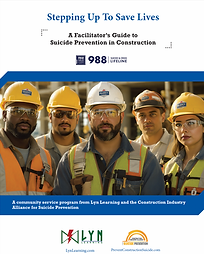

Construction Industry Expert Help
Have questions about how to use the toolbox talk on a job site or in a stand down? Book a call with Bill Aalerud who has 40 years of construction experience and he can answer your questions.

Free Custom Suicide Prevention Video

Generic Stepping Up To Save Lives Suicide Prevention In Construction 2026
-
We will replace the avatar in this video with someone from your company.
-
Book a 15 minute call with one of our team before August 24 to ensure delivery in time for Suicide Prevention Week Sept 14-18, 2026.
-
Recording the avatar takes 2 minutes reading a script and no further time is needed from you.
-
The file format delivered is an mp4 file.
-
When the Stepping Up video is emailed to you it can be put on a company intranet site (internal sharing with site supervisors) or embedded in a project management platform for easy sharing internally with site supervisors so that it can be used in a stand down or toolbox talk. The video may not be re-packaged or sold.
-
Need it languages other than English? Our avatars can speak 160 languages. No language class required.
Construction Industry Expert Help & Customization
Have questions about how to use the toolbox talk on a job site or in a stand down? Or, do you want to learn more about the free customization of the video? Book a call with Bill Aalerud and he can answer your questions.
Stepping Up to Save Lives in Other Languages

ES-US - Stepping Up To Save Lives Suicide Prevention In Construction
Spanish Stepping Up to Save Lives

PT - Generic Stepping Up To Save Lives Suicide Prevention In Construction 2026
Portuguese Stepping Up to Save Lives

FR - Stepping Up To Save Lives Suicide Prevention In Construction 2026
French Stepping Up to Save Lives

Join the Alliance for a virtual 5K rally. You can walk, swim, bike or any other way you want to accomplish the 5K. Sign up today!
Construction Suicide Prevention
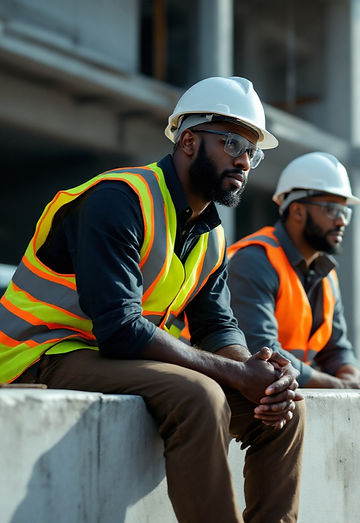
Construction is one of the most demanding industries in the country physically, financially, and emotionally. Workers face irregular hours, job insecurity, chronic physical pain, and a culture that has historically treated asking for help as weakness. The result is a suicide rate that significantly exceeds the national average, making mental health awareness on the job site a safety issue, not just a wellness initiative.
Lyn Learning developed the Stepping Up to Save Lives program in partnership with the Construction Industry Alliance for Suicide Prevention (CIASP) to give companies a practical, deployable way to address this. The program is built for the job site short-format, easy to share, and designed for the people who need it most.
Free materials include a 5-minute micro-learning video, a facilitator guide for site supervisors, and a resource guide for organizations. A customized version with your company's avatar, logo, and script is also available.
The goal is straightforward: more job sites where workers know that asking for help is not a sign of weakness.
Reaching People with Cutting Edge Technology
Lyn Learning has 27 years of instructional design and micro learning experience. We bring this expertise to the creation of professional micro learning videos with custom employee avatars. Research and current market trends demonstrate the power and appetite for learning with short video format. This innovative approach transforms familiar workplace faces into digital trainers who deliver bite-sized 3–5-minute training modules anytime and anywhere. The result is flexible, scalable training that employees remember and apply, whether for safety protocols, policy updates, or ongoing professional development.
Curious how microlearning or microvideos
can make your toolbox talks, safety programs and job site better and safer? Reach out today to set up a call.
Suicide Prevention in Construction
Frequently Asked Questions
Understanding the Problem of Suicide in the Construction Industry
Why is the suicide rate so high in the construction industry?
There's no single cause. Researchers point to a combination of factors: high rates of physical injury and chronic pain (which can lead to opioid use), seasonal and project-based work that creates financial instability, long hours away from family, and a workplace culture that discourages showing vulnerability. The CDC itself notes that more research is still needed to fully explain the disparity. Source: CDC/NIOSH — Partnering to Prevent Suicide in the Construction Industry
How many construction workers die by suicide each year?
The most current data shows the number is actually trending down: construction worker suicide deaths fell from about 5,100 in 2023 to roughly 5,000 in 2024, a 1.7% decline, with the suicide rate dropping from 43.2 to 41.9 per 100,000 workers. It's still an epidemic, but it marks measurable progress after years of increases.
Source: CPWR — Construction Worker Overdose Deaths Plummet, Suicides Decline (Feb 2026)
Is construction the #1 industry for suicide?
By occupation, yes, and increasingly so. Using the most recent available CDC mortality data (2023), construction and extraction is the occupational group with the highest suicide rate of any in the U.S., by a wide margin, for both men and women: about 69 per 100,000 for men and 22 per 100,000 for women. In absolute terms, that's roughly 5,100 construction workers a year, about five times the number who die in workplace accidents on construction sites. (Note: by broader industry classification rather than occupation, 2021 CDC data still ranks mining/oil and gas extraction slightly higher than construction, but by detailed occupation, construction and extraction now tops the list.)
What makes construction workers more at risk for suicide than other industries?
OSHA points to work-related stressors like seasonal layoffs, demanding schedules, physically demanding jobs and high injury rates as key drivers. CPWR research also highlights the industry's high rate of opioid-related deaths, often linked to workplace injuries, as a compounding risk factor.
Sources: OSHA — Preventing Suicides in Construction | CPWR Suicide Prevention Resources
What is the suicide rate for construction workers compared to the national average?
Using the most recent available data (2023 CDC mortality microdata), male construction and extraction workers die by suicide at a rate of about 69 per 100,000, compared to the overall U.S. male suicide rate of 22.7 per 100,000 that same year. That's roughly three times the general male rate. For construction laborers specifically, the rate is even higher, at 96 per 100,000, compared to 48 per 100,000 for construction managers, showing the risk isn't spread evenly even within the industry. Older estimates citing "four times higher" (OSHA, DOL) were based on earlier data and comparison groups, so you may see a range of multipliers depending on the year and methodology used.
Sources: American Institute for Boys and Men — Male Suicide Trends by Class and Occupation (2025, using 2023 CDC data) | CDC/NCHS — Suicide Rates Largely Unchanged in 2023, but Still High
Why don't construction workers talk about mental health?
Stigma is the biggest barrier. Industry leaders describe a "tough it out" culture where the same traits that make someone a great construction worker: toughness, self-reliance, a get-it-done mentality, can also make it harder to ask for help.
Source: Safety+Health Magazine — Suicide Prevention in Construction
Suicide Prevention Week / Month 2026
When is Construction Suicide Prevention Week 2026?
Construction Suicide Prevention Week 2026 runs September 14–18, 2026, during National Suicide Prevention Month.
Source: Construction Suicide Prevention — How to Participate
When is National Suicide Prevention Month?
National Suicide Prevention Month is observed every September across the U.S. — a time dedicated to raising awareness, promoting hope, and connecting people to resources, warning sign education, and open conversations about mental health. The construction industry's dedicated awareness week falls within this broader month.
Source: SAMHSA — Suicide Prevention Awareness Month
What is Construction Suicide Prevention Week?
It's an industry-wide initiative, launched in 2019 by a volunteer group of construction professionals, dedicated to raising awareness of the high suicide rate among construction workers and sharing prevention resources across job sites nationwide. Source: Construction Suicide Prevention — About
How can my company participate in Construction Suicide Prevention Week?
You can share a toolbox talk, plan a company stand-down, provide training and have leadership address the topic. This page on Lyn Learning provides resources that are free to use. You can also register your company at constructionsuicideprevention.com, then set aside 20–30 minutes per day, per job site during the week for toolbox talks and activities — topics typically include construction and suicide, reducing stigma, and recognizing warning signs. Many companies also share resources on social media and distribute wristbands or hard hat stickers. Source: Construction Suicide Prevention — How to Participate
What is a "stand-down" for suicide prevention?
A stand-down is a company-wide pause in work. A stand-down can include information about suicide prevention as well as a minute of silence to honor lives lost to suicide and recommit to prevention efforts. It mirrors the safety stand-downs many construction companies already use for physical safety topics.
Source: Construction Suicide Prevention — 2026 Stand Down
What is World Suicide Prevention Day?
World Suicide Prevention Day is observed every September 10, organized internationally by the International Association for Suicide Prevention (IASP) and the World Health Organization (WHO) to raise global awareness about suicide prevention. Source: National Today — Suicide Prevention Week 2026
Suicide Prevention Resources & Support for Construction
Where can I find mental health resources for construction workers?
Several organizations offer construction-specific resources: CPWR (Center for Construction Research and Training), CIASP (Construction Industry Alliance for Suicide Prevention), OSHA and Lyn Learning all maintain free, downloadable materials, including toolbox talks, training modules, and hazard alerts. Sources: CPWR | CIASP | OSHA
What is the 988 Suicide & Crisis Lifeline?
988 is a free, confidential national hotline available 24/7 by call, text, or chat for anyone experiencing a suicidal crisis or emotional distress. It is also a resource for friends and family of people who need help. It launched nationwide in July 2022 and has become a standard resource cited across construction industry safety materials.
Source: National Today — Suicide Prevention Week 2026
What organizations help with suicide prevention in construction?
Key organizations include CIASP, CPWR, OSHA, and the American Foundation for Suicide Prevention (AFSP) — the latter three formally partner through an OSHA alliance dedicated to workplace mental health and suicide prevention.
Source: OSHA — AFSP/CIASP/SST Alliance
Are there free toolbox talks for suicide prevention?
Yes. This page has the Lyn Learning resources that includes a video and materials for a toolbox talk on suicide prevention. In addition, CPWR's Hazard Alert on suicide prevention, the "You OK?" Construction Facilitator Guide from the Healthier Workforce Center, and the daily toolbox talk topics distributed during Construction Suicide Prevention Week are all free to download and use on site. Sources: CPWR Hazard Alert | You OK? Facilitator Guide
What is CIASP (Construction Industry Alliance for Suicide Prevention)?
CIASP is a 501(c)(3) nonprofit, originally formed as a task force under the Construction Financial Management Association (CFMA) in 2016, dedicated to providing suicide prevention resources and building a "zero-suicide industry."
Source: CIASP — Home Taking Action / Prevention Programs
How to implement a suicide prevention program on a construction job site?
Effective programs typically combine leadership buy-in, regular training (like CPWR's free "Building Resilience" modules), scheduled toolbox talks, visible crisis resources (988, EAP info), and a workplace self-assessment to identify gaps. The National Action Alliance's Construction Industry Blueprint is a widely used starting framework. Some companies offering specialized training to employees who want to support suicide prevention, they partner with local suicide prevention organizations and they focus on building a job site culture where people feel that they can speak up and to ask or offer help. Sources: CPWR Building Resilience | National Action Alliance — Construction Blueprint
How do I talk to a coworker who might be suicidal?
Start by simply asking if they're okay — and be prepared to ask more than once. Industry experts note that people often give a reflexive "I'm fine" the first time, so it helps to be gently persist, listen without judgment, and connect what you're noticing to specific behavior changes you've observed.
Beyond that first conversation, the National Institute of Mental Health (NIMH) recommends five evidence-based steps, known as #BeThe1To, for supporting someone who may be having thoughts of suicide:
-
Ask directly. "Are you thinking about suicide?" Research shows asking this question does not increase suicidal thoughts or behavior — it opens the door to a real conversation.
-
Be there. Listen without judgment. Simply acknowledging and talking about suicide can actually reduce suicidal thoughts rather than increase them.
-
Help keep them safe. If they have a plan, ask about it directly and work to reduce access to lethal means (firearms, pills, etc.) until the immediate risk passes.
-
Help them connect. Point them toward the 988 Suicide & Crisis Lifeline (call or text 988), an Employee Assistance Program, or a trusted person — and if you believe they're in immediate danger, don't leave them alone.
-
Follow up. Check back in over the following days and weeks. Staying connected after the initial conversation is one of the most protective things you can do.
A note on language: industry trainers also recommend saying someone "died by suicide" rather than "committed suicide," and avoiding words like "weak" or "selfish" — small shifts that reduce stigma and make these conversations easier to have on site. Sources: Safety+Health Magazine — Suicide Prevention in Construction | NIMH — 5 Action Steps to Help Someone Having Thoughts of Suicide
What are the warning signs of suicide risk in construction workers?
Common warning signs include noticeable changes in behavior, mood, or what someone says about themselves or their future. OSHA advises taking any of these signs seriously rather than waiting to see if they pass.
Source: Arcoro — Protect Your Workers: Bring Awareness to Suicide Risk
What should a supervisor do if they suspect a worker is struggling?
Talk to them privately, ask directly, and listen without judgment. OSHA recommends taking the conversation seriously and connecting the worker to resources like an Employee Assistance Program (EAP) or the 988 Lifeline rather than trying to resolve it alone. Source: OSHA — Preventing Suicides in Construction
How do you reduce stigma around mental health on a job site?
Language matters, industry trainers recommend using "die by suicide" rather than "commit suicide," and avoiding words like "weak" or "selfish." Beyond language, visible leadership involvement and normalizing conversations about stress and mental health both help chip away at stigma over time.
Source: CIASP presentation materials, Colorado Department of Public Health & Environment
What training is required for suicide prevention in construction?
There's no single federal mandate specifying suicide prevention training, but OSHA strongly recommends it as part of a comprehensive safety program. CPWR's "Building Resilience" is a free, discussion-based training with nine modules covering mental health, suicide awareness, and related topics that many companies use to fill this gap.
Source: CPWR Suicide Prevention Resources
How can employers support mental health in construction?
Effective steps include offering an EAP, making naloxone available on site to address opioid-related risk, training supervisors to recognize warning signs, posting crisis resources visibly, conducting toolbox talks about the topic, providing training to employees who volunteer to help support mental health efforts and building a culture where asking for help isn't seen as a weakness. Source: ABC Southern California — Construction Worker Suicide Prevention
Compliance / Employer-Focused
Does OSHA require suicide prevention training?
No — there's no specific OSHA standard mandating suicide prevention training. However, OSHA actively promotes it through its formal alliance with AFSP, CIASP, and Stop Stigma Together, and provides free resources including toolbox talk topics and a dedicated webpage. Source: OSHA — Preventing Suicides in Construction
What is a suicide prevention toolbox talk?
It's a brief, informal safety-meeting format — typically one page and a few minutes long — used to introduce a mental health topic on site. Common topics include recognizing warning signs, reducing stigma, and how to start a conversation with a struggling coworker. Source: You OK? Construction Facilitator Guide, Healthier Workforce Center
How much does workplace suicide cost the construction industry?
There isn't a single, verified industry-wide dollar figure for the U.S. construction sector specifically. This is worth flagging if you've seen a specific number circulating, since it may not hold up to scrutiny. What is well-documented is that mental health struggles and turnover carry real costs: replacing an employee typically costs 50–200% of their annual salary once lost productivity, recruitment, and training are factored in, and construction's turnover and absenteeism costs compound when mental health goes unaddressed. Source: Stand Together — The Hidden Cost of Ignoring Employee Burnout
If you are personally struggling with thoughts of suicide,
call or text 988 to reach the Suicide & Crisis Lifeline, available 24/7.